How to Hire a Video Editor Without Spending the 39 Days a Typical Hire Takes
How to hire a video editor in about a week: shortlist 3 to 5 candidates and use one paid test on real footage to assess clip choices and turnaround.
Freelancer, editing service, or employee: which hire are you actually making?
Your hiring model determines what you buy and how you compare quotes. An employee earns a salary, with benefits and payroll costs beyond that figure. A freelancer may charge hourly, per project, or per finished minute.
An editing service usually sells defined deliverables or monthly production capacity. Those different units explain why online pricing advice can seem contradictory.
For freelancers, search creator communities, freelance marketplaces, and relevant “for hire” discussions. Job boards suit employee searches, while a YouTube video editing service can provide an established ordering and feedback process.
This guide helps you select an editor or service for recurring content, then confirm the choice through a paid test. Full-time recruiting, editing tutorials, and comprehensive rate cards fall outside its scope.
Why does the first month with a new editor go wrong?
The first videos arrive late or need two or three revision rounds. Often, the buyer selected an editor from a polished reel assembled from somebody else’s footage.
That reel demonstrates finishing ability. However, much of a talking-head edit involves deciding what to keep, remove, reorder, and emphasize. Without the original footage, you cannot inspect those decisions.
The buyer then requests a free sample without a brief or deadline. Because the exercise lacks normal production conditions, it offers weak evidence of selection judgment or reliable delivery.
The root problem is a missing paid, briefed, deadline-based test using the buyer’s material. Match that test to the format you publish: short-form video editing requires different selection and pacing decisions than a longer educational video.
How long should hiring a video editor take?
SHRM’s 2026 recruiting benchmark puts median time-to-fill at 39 calendar days for nonexecutive salaried positions. That measures requisition opening through offer acceptance, rather than the time required to place a freelance order.
A freelance or service decision can happen within days because one test becomes the decision point. Treat a week as a practical target for a small assignment, subject to the editor’s availability and your feedback speed.
Here is a suggested sequence:
- Day 1: Shortlist three to five candidates with relevant work.
- Day 2: Ask the five screening questions below.
- Day 3: Agree on payment, footage, scope, and a written test deadline.
- Days 4 through 6: Review the cut and complete the agreed revision.
- Day 7: Continue, adjust the brief, or test another candidate.
This schedule is a planning example, not a universal turnaround promise. Waiting for replies, clarifying incomplete briefs, and leaving deadlines undefined usually stretch the process.
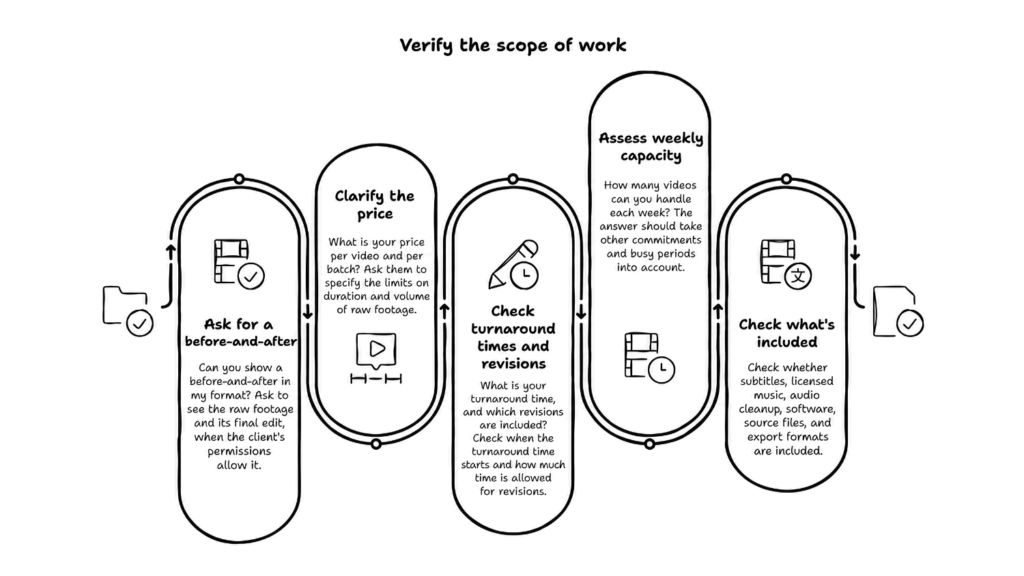
What five questions should you ask a video editor before hiring?
Send every candidate the same questions. Their answers let you compare scope and communication before spending money.
You are checking whether someone understands your production needs and responds directly. Missing answers deserve clarification before the test begins.
1. Do you have a portfolio for this exact video type?
Ask for complete examples resembling your talking-head videos, podcast clips, Shorts, or ads. A strong response identifies comparable work and explains the editor’s contribution.
An evasive response offers only a cinematic montage or unrelated animation. Visual polish matters, but format familiarity deserves its own check.
2. What is your price per video and per batch?
Request a single-video quote and a recurring-batch quote for the same scope. Good answers specify the pricing unit, expected total, and potential extras.
A bare hourly rate without an estimated workload leaves your budget unresolved. Likewise, a monthly price needs defined deliverables, duration limits, and footage allowances.
3. What is your turnaround from footage received to first cut?
Ask for normal business-day turnaround, including the point when the clock starts. A useful answer explains whether complete assets, payment, or brief approval triggers production.
“ASAP” gives you little scheduling information. Confirm revision timing separately, since a first-cut deadline does not establish the final delivery date.
4. How many videos can you deliver each week?
Specify finished length and typical footage volume. Strong answers give realistic weekly capacity and explain how holidays or existing commitments affect it.
“As many as you need” deserves follow-up. For recurring content, ask whether your monthly allocation supports the weekly publishing pattern you actually need.
5. What is included?
Confirm revision rounds, captions, B-roll, music, audio cleanup, color correction, thumbnails, and exports. Ask separately about project files and licensed assets.
A clear response separates included work from add-ons. “Everything included” without boundaries can create disagreements over sourcing, graphics, or additional formats.
What does a video editor cost, and what changes the price?
For experienced freelancers serving the US market, budget roughly $50 to $100 or more per hour. Short social edits may cost around $50 to $250 per project, while a 10-minute YouTube edit can run approximately $500 to $2,000.
These are broad planning ranges, not minimums or universal fair prices. Simpler, standardized services may charge less; demanding footage, animation, or extensive research can push costs higher.
For context, the BLS median annual wage for film and video editors was $75,420 in May 2025. That historical employee wage excludes the business expenses and unpaid administrative time reflected in freelance quotes.
Raw footage volume, finished length, captions, B-roll research, revision rounds, and rush deadlines all move the price. Compare the total cost of your normal deliverable, including extras, rather than choosing by the lowest headline rate.
How do you judge what an editor chooses to keep and cut?
Ask this directly: “Walk me through how you pick the best clips from an hour of footage.”
A strong answer starts with the viewer’s question or opening hook. It covers removing repetition, shortening setup, preserving proof, and matching pace to the platform.
Weak answers focus entirely on software, transitions, or visual effects. Those skills matter, but they do not explain how the editor recognizes the moments your audience needs.
Then check the explanation against the paid test. Compare the finished cut with the raw footage and note what disappeared.
For example, imagine a coaching video with a repeated introduction and a useful client example. Cutting the repetition helps; removing the example may leave an unsupported claim. Check whether the edit preserves context, qualifications, and the intended meaning.
This review turns “I like the style” into a concrete assessment of editorial judgment.
How should you run a paid test edit?
Treat the test as a small production order. Payment respects the editor’s time and creates conditions closer to the ongoing relationship you want.
Match the test to your actual work
Use your own footage in the format you intend to publish. To hire a YouTube video editor, test a representative YouTube assignment rather than assuming a good Short proves long-form ability.
Keep the scope manageable. One short video or a clearly defined section of a longer video can expose selection judgment without requiring a large commitment. Include enough context for the editor to understand the intended story.
Agree on price, deadline, and feedback
Budget roughly what that normal deliverable would cost. Confirm the first-cut deadline, time zone, export format, and one revision round you will evaluate, even if the provider allows more.
IntentClose offers paid single-video and short orders with a stated 72-hour delivery window. Confirm the clock’s starting conditions before ordering; its late-delivery promise is “Late? Your next one is free.”
Score the result before committing
Set your pass criteria before seeing the edit. That prevents impressive graphics from distracting you from a missed brief or weak clip selection.
- Scope and price match the agreement, without unexplained extras.
- The first cut arrives on time and follows the brief.
- Clip choices preserve meaning, proof, and a useful opening.
- Audio, captions, pacing, and exports meet your publishing requirements.
- Feedback is handled clearly, revisions arrive as agreed, and recurring capacity is confirmed.
One successful test cannot guarantee week-four reliability. Follow it with a manageable batch and track deadlines before expanding your monthly commitment.

What should your brief to a video editor include?
Your brief is the buyer’s half of the test. A short, specific document gives the editor a clear target and makes feedback easier to resolve.
Include the following:
- Goal, audience, and target length: explain the viewer’s problem and intended next action.
- Must-keep and must-cut material: identify essential proof, repeated sections, private details, and unsuitable takes.
- References and brand assets: share examples with explanations, plus fonts, colors, logos, and caption preferences.
- Delivery requirements: specify resolution, aspect ratio, file type, naming convention, deadline, and time zone.
- Feedback process: identify one decision-maker and send one consolidated list with timecodes.
For example, “keep the demonstration at 04:12 because it proves the main claim” gives actionable direction. “Make it more engaging” leaves the editor guessing about your priorities.
A missing instruction can become another revision round. If captions are required but never mentioned, both sides may work from different expectations.
For white-label agency work, add client-specific branding, confidentiality expectations, file ownership, and approval responsibilities. Your editor should know whether feedback comes directly from you or passes through another reviewer.
Which red flags should end a hire before the first invoice?
Pause when candidates lack comparable examples or avoid defining revision terms. A quote without a unit, such as per hour, video, or finished minute, also needs clarification before payment.
Unclear turnaround and unsupported capacity promises make recurring production difficult to schedule. Pressure to purchase a monthly package before seeing one finished deliverable adds unnecessary risk.
A refusal to take any reasonable paid trial warrants discussion. Some established editors have minimum project sizes, so distinguish a clear commercial boundary from evasiveness.
Once the test starts, an unexplained missed deadline or ignored feedback is stronger evidence than an impressive portfolio. Assess how the editor communicates problems and proposes recovery.
Your process matters too. Unpaid tests, missing assets, shifting requirements, and scattered feedback can drive away capable editors. Give candidates the same clarity and reliability you expect from them.
Conclusion
A freelance video editor or editing service can be evaluated within days through a well-scoped paid test, rather than the 39-day median hiring cycle for salaried roles. Put IntentClose to the test with one short or one YouTube video using your own footage, then increase your commitment only after the clip selection, delivery, and revisions meet your requirements.
Key takeaways
- Start with a paid test on your footage, with a clear brief, deadline, and revision round.
- Aim for a one-week selection process; the 39-day benchmark applies to salaried hiring.
- Screen for relevant work, pricing, turnaround, weekly capacity, and included deliverables.
- Compare total costs, including footage volume, captions, revisions, and extras.
- Evaluate clip selection and preserved meaning, alongside technical quality and responsiveness.
- Expand to recurring batches only after the test meets your agreed criteria.
FAQ
How do you know a freelance video editor for hire will understand your content format?
Ask for complete examples that match your format, audience, and typical length, then hire for a paid test on your own footage. A polished reel is easy to trust, but it often comes from somebody else's footage, so you cannot see what the editor chose to keep or cut.
Judge the test by the decisions you can check: what stayed, what disappeared, and whether the opening still hooks your viewer. That tells you more about fit for your channel than any showreel.
What do video editing services really cost for YouTube videos and short-form content, and which extras can inflate the quote?
As a broad US market range, short social edits cost around $50 to $250 per project, and a 10-minute YouTube edit runs roughly $500 to $2,000. Experienced freelancers often charge about $50 to $100 or more per hour.
Surprises usually come from what the quote leaves out. Before you compare offers, confirm the footage allowance, the number of revision rounds, and extras such as captions, B-roll, and rush delivery. Then compare the total for your normal deliverable instead of the lowest headline rate.
Is a freelancer the right choice for recurring content, or should you hire an employee or a video editing service?
A freelancer is a good fit if you want a direct relationship and have time to manage scheduling and feedback. An editing service tends to suit predictable batches and an established workflow. An employee makes sense once your ongoing workload and coordination needs justify salary and employment costs.
With either outsourced option, test one finished deliverable before you pay for monthly capacity. One good result will not guarantee reliability in week four, so start with a small batch and track deadlines before you expand.
Sources & references
Finished episodes in 72 hours, checked frame by frame.
Get your YouTube edit
Written by
Tanguy Hubner · Founder, IntentClose
The pipelines are built, not bought. I wrote the automations that run these three services, and I keep them updated with the latest tech. The final pass is always mine: 163 reviews, 1,000+ deliveries, 11 years in the trade.
This article came out of the same pipeline I run for clients. Let me write yours →
More about how I work → Find me on LinkedIn