
How Much Does a Video Editor Cost in 2026? One Finished Minute Can Take an Hour to Edit
In 2026, YouTube video editing rates range from $500 to $2,000 for a 10-minute video. Each finished minute can take an hour to edit.
How much does a video editor cost in 2026?
For US buyers, budget roughly $50 to $250 for a simple short or $500 to $2,000 for a 10-minute YouTube edit. Hourly editing can range from $10 to $150 or more. Video podcasts follow long-form pricing, with extra work for camera syncing and audio cleanup.
These are editing-only estimates for footage you already have. Filming, production crews, locations, and your own software subscriptions fall outside this budget. This guide helps you compare purchases, rather than set freelance rates.
US budgeting benchmarks for 2026
Entry-level freelance video editor rates can fall around $10 to $30 per hour. General editing often runs around $30 to $60, while experienced specialists may charge $60 to $150 or more.
Monthly editing services span approximately $500 to $4,000, depending on output and capacity. Larger agency retainers can run around $5,000 to $16,000 monthly.
Start by identifying the billing unit: hours, finished minutes, individual videos, or monthly capacity. When comparing YouTube video editing packages, check whether each quote includes footage review and revisions.
Most 7-minute videos are cut from 15 to 90 minutes of footage.
A cinematic house bills $1,106 to $2,100 for the same 14 finished minutes.
Order 2 videosWhy do quotes for the same video range from $200 to $2,000?
Quotes become easier to compare when you separate three variables: the pricing unit, the complexity tier, and footage review. An hourly editor exposes labor directly. A flat-price editor bundles the expected hours into one amount.
For example, eight hours at $40 to $60 per hour produces a $320 to $480 labor estimate. A project quote within that range could cover exactly the same assignment.
The difference appears when assumptions change. One quote might cover cuts and captions from selected footage. Another might include reviewing every take, finding B-roll, repairing audio, and creating animated graphics.
Ask both editors to price the same brief. Specify raw-footage duration, finished runtime, reference style, revision rounds, and deadline before deciding which offer provides better value.
What actually drives the price of an edit? From finished minutes to footage hours
A three-minute promotional video can require more work than a 30-minute interview. Editors sell production time, and finished runtime captures only part of that workload.
First, raw footage creates review work. Someone must watch, sort, label, sync, and select material before shaping the story. A 10-minute edit from 45 minutes of footage has a 4.5:1 source-to-delivery ratio; the same runtime from several hours requires more selection.
Next, the style adds labor. Animated captions, custom motion graphics, sound design, and detailed color grading require additional passes.
Finally, uncertainty affects the quote. Without seeing the footage or knowing the approval process, an editor may include contingency in a flat fee. You pay for that risk through the bundled price.
For predictable short-form video editing, define a footage cap and supply selects where possible. For longer videos, ask for footage handling and editing to be itemized, with clear revision boundaries.
How long does it take to edit one finished minute of video?
Use 45 to 60 minutes of editing per finished minute as a planning assumption, not a universal average. Simple talking-head content may need about 20 to 30 minutes. Stylized, motion-heavy work can require one to two hours or more.
For a 10-minute video, those assumptions translate into approximately 3.5 to 5 hours for simple work. A moderately polished edit may require 7.5 to 10 hours, while a graphics-heavy version could take 10 to 20 hours or longer.
Allow additional time for feedback. A provisional revision allowance of 10% to 25% of first-cut time can help budgeting, but structural changes may exceed it.
Also distinguish labor hours from turnaround. Ten working hours can stretch across several calendar days because of scheduling, uploads, rendering, and approvals. Ask whether the promised delivery date means the first cut or the approved final video.
How do you estimate your own video's editing cost from your footage?
A useful video editing cost calculator needs more than the final runtime. Here is a three-step method:
- Multiply finished minutes by the editing time your style requires.
- Add footage review, preparation, revisions, and delivery work not already included.
- Multiply total labor hours by the editor’s hourly rate, then add separately priced assets or services.
Avoid double-counting footage review. If an editor’s time-per-minute estimate already includes watching the material, do not add the same work again.
A one-minute short
Assume a selected clip needs 30 to 60 minutes of straightforward editing. At an illustrative $40 to $85 hourly rate, that represents roughly $20 to $85 in editing labor.
The invoice can still reach $50 to $250 because briefing, captions, exports, and minimum project fees matter. A 45-second short may cost much the same as a one-minute clip when both require identical setup.
A 10-minute YouTube video
Using 7.5 to 10 editing hours at $40 to $85 per hour produces approximately $300 to $850 in base labor.
Now account for the source material. If the editor watches all 45 minutes of footage at normal speed, viewing alone takes 45 minutes. Logging, selecting, captions, graphics, and revisions add more work. A broader project budget of $500 to $2,000 allows for these differences.
A 20-minute video
Budget approximately $600 to $1,700 in base editing labor under the same assumptions: 15 to 20 hours multiplied by $40 to $85 per hour.
Extensive footage review, custom B-roll research, or complex audio can push the total higher. For a useful quote, submit the raw-footage duration alongside your target runtime.
Short-form vs. long-form: how does the price unit change?
Short-form content usually sells per clip or in clip packs. Long-form YouTube work may sell per finished minute, per video, hourly, or through a monthly allocation.
The practical comparison comes down to what each unit includes.
Short-form clips
For Reels, TikTok videos, and YouTube Shorts, a general planning range is $50 to $250 per simple clip. Costs depend on clip count, hook development, captions, effects, and how much footage needs searching.
You might supply one selected excerpt or a limited batch of raw footage. Allow a few days to a week as a scheduling estimate, subject to the editor’s queue and feedback speed.
Long-form YouTube videos
A 10- to 20-minute edit may fall around $500 to $1,500 for relatively straightforward work. More polished projects can reach $2,000 or more.
Inputs often include multiple takes, camera angles, separate audio, and B-roll. Several days to two weeks can be a reasonable planning window.
A clip price stays predictable when footage and styling are capped. Long-form costs rise when the editor must search more material or build a more involved narrative, even if the delivered runtime stays unchanged.
Freelancer, agency or in-house editor: what does each really cost?
Your choice changes both the invoice and the work your team must manage. Compare total coordination costs alongside the editing fee.
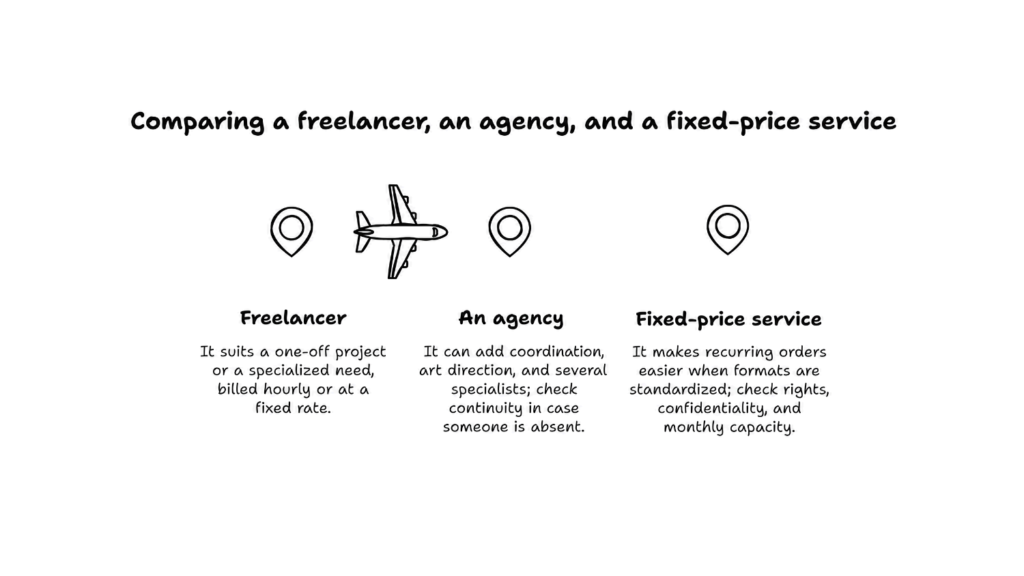
Freelancer or productized service
A freelancer can be economical for a defined project, especially when you provide organized footage and consolidated feedback. You usually remain responsible for scheduling, approvals, and backup arrangements.
A productized service sells defined deliverables or monthly capacity. Plans around $500 to $4,000 can simplify recurring budgets, but check footage limits and how many projects can run simultaneously.
A monthly video editing service suits creators with steady publishing schedules. Occasional buyers may get better value from individual projects.
Agency or white-label partner
Agency pricing can include project management, specialist coverage, and quality control. Higher fees may be worthwhile when missed deadlines or inconsistent branding create significant business costs.
For agencies choosing a white-label video editing service, confirm resale rights, watermark-free delivery, confidentiality, and client-facing approval responsibilities. Calculate your margin after footage charges, revisions, and account-management time.
United States: what BLS salary data measures
The U.S. Bureau of Labor Statistics distinguishes film and video editors from camera operators. Compare the correct occupation and wage year when evaluating an employee against outsourced editing.
Salary is only part of employment cost. Add payroll taxes, benefits, equipment, software, management, and paid downtime.
Freelancers also cover tools, administration, and nonbillable hours through their rates. An in-house editor becomes easier to justify when you have consistent daily work and need close creative collaboration.
What's included in a quote, and what costs extra?
A low headline price becomes useful only after you define the deliverables. Request written answers before paying:
- Does the price include reviewing all raw footage, syncing cameras, and selecting usable takes?
- How many revision rounds are included, and what counts as a scope change?
- Does turnaround cover the first cut or final approval, and what does priority delivery cost?
- Are captions, audio cleanup, color correction, music licenses, motion graphics, and thumbnails included?
- Will you receive the editable project files, linked assets, and every required export format?
Treat any rush premium as a separate quote item. For a provisional budget, you could reserve 25% to 50% extra, but confirm the actual charge rather than assuming a standard surcharge.
Clarify the details behind broad labels. Basic color correction differs from a custom grade. Captions might mean burned-in text, a separate subtitle file, or both.
When a plan promises unlimited revisions, ask what limits throughput. Queue length, active-project caps, response time, and scope rules still affect how much content you receive.
How do you lower the editing bill without lowering the quality?
Reduce footage-handling time and avoid unnecessary revision cycles. Those two levers often matter more than negotiating a lower hourly rate.
Send selects instead of every take whenever your team can make those choices efficiently. Pair them with a short brief and one reference video showing the desired pacing and visual style.
Batch recurring videos and reuse approved templates for captions, intros, lower thirds, and exports. Monthly packages can reduce repetitive setup, but only buy capacity you expect to use.
Collect feedback from everyone involved before sending one consolidated revision request. Separate corrections from new creative directions so the editor can estimate additional work clearly.
A cheaper option is often appropriate for clean talking-head footage, a repeatable format, and low-risk experimentation. Spend more when complex storytelling, launch deadlines, or custom graphics justify the additional labor.
To compare a fixed-price option, try IntentClose’s short-form and YouTube service-page calculators: a 45-second short is $45, while a 10-minute YouTube edit from 45 minutes of raw footage totals $345 one-off or $325 using the 10-minute pack. Its offer includes a 72-hour delivery target and revisions until approval; check footage allowances and optional extras before ordering.
Conclusion
Video editing costs in 2026 depend on the labor behind the finished runtime, with raw footage review helping explain why quotes for the same video vary so widely. Compare quotes for an identical scope, then use a service calculator to check the total editing budget before ordering.
Key takeaways
- Budget $50 to $250 for a simple short or $500 to $2,000 for a 10-minute YouTube edit, excluding filming.
- Hourly editing rates range from $10 to $150 or more, depending on experience and specialization.
- Allow roughly 45 to 60 minutes of editing per finished minute, with more time for complex graphics.
- Raw-footage volume, editing style, revisions, and deadlines drive quote differences.
- Compare identical scopes, including footage review, revision limits, licenses, and export formats.
- Lower costs with selected footage, reusable templates, and consolidated feedback.
FAQ
How much should you budget per finished minute of video editing in 2026, and why can that number mislead you?
Plan on about $50 to $200 per finished minute, based on a 10-minute YouTube project costing $500 to $2,000. Treat it as a project-derived estimate, since no universal market average exists.
The number can mislead you with short clips and graphics-heavy videos, where the per-minute economics look very different. Judge any quote by what it includes, not by its per-minute price alone.
What do people most often forget when using a video editing cost calculator?
Most people forget everything except the final video length. A reliable video editing cost calculator also needs your raw-footage duration, camera count, footage selection, captions, graphics, audio cleanup, revisions, and deadline.
Add thumbnails, licensed assets, and alternate exports if you need them. Before you trust the total, check whether footage review is already built into the editing estimate, so you neither pay for it twice nor miss it entirely.
If you publish every week, is a monthly video editing service safer than paying per video?
A monthly video editing service is the safer choice when your volume and format stay consistent from week to week. If your schedule shifts often, paying per video protects you from buying capacity you never use.
Before you commit, compare the effective price per completed video, the footage allowance, and the turnaround time. Unused monthly capacity is the most common trap, so only buy what you realistically expect to fill.
Sources & references

Written by
Tanguy Hubner · Founder, IntentClose
The pipelines are built, not bought. I wrote the automations that run these three services, and I keep them updated with the latest tech. The final pass is always mine: 163 reviews, 1,000+ deliveries, 11 years in the trade.
More about how I work → Find me on LinkedIn