Is Hiring a YouTube Editor Worth It When Each Finished Minute Takes Up to an Hour to Cut?
A 10-minute video can take 5 to 10 hours to edit. YouTube video editing services pay off when the time saved after review is worth more than the total fee.

What are you actually buying when you hire a YouTube editor?
A YouTube video editing service turns your raw footage into a publishable cut. Depending on scope, that includes pacing, removing dead air, adding b-roll, captions, music, audio cleanup, and revisions.
You are primarily buying back production hours. Stronger editing can support audience retention, but views, subscribers, and revenue remain uncertain. Evaluate the time recovered before assuming growth will cover the bill.
Channel strategy, scripting, publishing, and thumbnail design usually require separate agreements. Hiring an editor also does not automatically reserve their full working week.
For Shorts or Reels, short-form video editing is usually priced per clip rather than per finished minute. Individual clips generally cost less than long-form projects, although custom animation can change that comparison.
Where do the hours go when you edit your own videos?
A slipping upload schedule often starts with editing competing against scripting, filming, and paid work. Footage accumulates faster than you can turn it into finished videos.
For planning, allow roughly 30 to 60 minutes of editing per finished minute. That puts a 10-minute YouTube video at approximately 5 to 10 hours. Treat this as a rule of thumb, not a measured universal average.
The first cutting pass often consumes the largest share. You might review 45 to 60 minutes of footage to keep seven to 10 useful minutes. Every retake, pause, and repeated explanation needs a decision.
Faster software helps with transcription, silence detection, and exports. However, it cannot consistently determine which explanation best serves your audience without editorial judgment.
A repeatable format reduces those decisions. Give an editor a fixed structure, reference video, and organized footage, and you can delegate the recurring cutting pass instead of rebuilding it yourself.
What does a YouTube editor cost per finished minute, per video and per month?
YouTube editor rates vary substantially with footage volume, complexity, and delivery requirements. Compare these three billing models before comparing providers.
Per finished minute
Indicative budgets range from roughly $25 to $150 or more per finished minute. Straightforward recurring formats sit toward the lower end; cinematic storytelling and motion-heavy work can push costs upward.
Calculate the effective rate by dividing the complete editing charge by the approved runtime. Check whether minimum orders, footage charges, or revision fees change that figure.
Per video
A flat project fee covers a defined deliverable. For a simpler long-form edit, a planning range of approximately $100 to $400 may be useful. More involved freelance projects can run around $500 to $1,500 or more.
Scope matters more than runtime alone. A three-minute talking-head edit may require less work than a similarly short video assembled from interviews and custom graphics.
Monthly pack or retainer
Entry-level recurring plans can fall around $300 to $600 monthly. Reserved editor capacity, heavier production, or agency support can move budgets into several thousand dollars.
For US budgeting, compare quotes in USD and check applicable taxes and payment fees. Divide the monthly bill by the finished minutes you actually use, rather than the allowance you purchase.
Across all three models, examine raw-footage billing. A 10-minute video assembled from 60 minutes of footage requires much more review than one assembled from 15 minutes.
Most 7-minute videos are cut from 15 to 90 minutes of footage.
A cinematic house bills $1,106 to $2,100 for the same 14 finished minutes.
Order 2 videos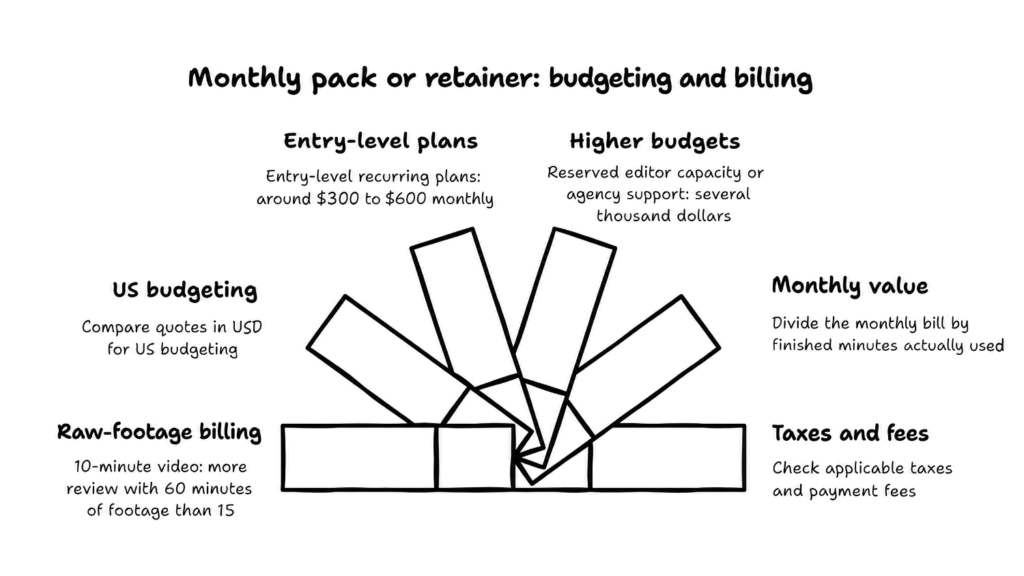
Why do quotes for the same YouTube video range from $50 to $400?
A wide quote spread usually signals different assumptions about the job. The lowest price may cover basic cuts from selected footage, while the higher quote includes editorial decisions and polish.
Compare four variables before deciding which offer represents better value:
- Raw footage volume and the number of camera angles.
- Finished runtime, graphics, captions, and sound requirements.
- Editor specialization and the level of individual attention.
- Included revision rounds and charges for scope changes.
Bulk production and dedicated freelance editing also involve different workflows. Either can work when the brief matches the production model.
A cheap first draft can become expensive after repeated corrections. Carry that review burden into your break-even calculation instead of treating your management time as free.
How do you run the break-even math on your own upload schedule?
Start with your current editing time and the value of a productive hour. Use a realistic value for scripting, filming, client work, or sales, rather than an aspirational billing rate.
Value of self-editing time = monthly finished minutes × editing hours per finished minute × your hourly value.
Total outsourcing cost = editing bill + footage fees + other charges + (briefing and review hours × your hourly value).
These formulas compare the same workflow two ways. Avoid subtracting review time from recovered hours and then charging for it again.
Worked example: two seven-minute videos
Assume you produce two seven-minute videos from 45 minutes of footage each. At 45 minutes of editing per finished minute, you spend 14 × 0.75 = 10.5 hours editing monthly.
Using an illustrative hourly value of $40, those hours represent $420. Replace that hourly value with your own realistic opportunity cost.
Suppose your hypothetical monthly quote totals $350 to $450, including review of all 90 raw minutes. Two hours of briefing and review add $80 of your time.
Your complete outsourcing cost becomes $430 to $530. On time value alone, that exceeds $420, so the verdict is not yet.
At an hourly value of $60, self-editing represents $630. Outsourcing, including two management hours, totals $470 to $570. That makes hire now more attractive, provided you can use the recovered time productively.
Choose your verdict
Hire now when the complete cost falls comfortably below the value recovered. Not yet fits when the economics remain unfavorable.
Choose test first when the numbers are close or review time is unknown. Personal downtime can also justify outsourcing, but treat that as a deliberate lifestyle expense rather than guaranteed financial ROI.
When does hiring an editor cost you more time than it saves?
Delegation creates its own workload: preparing files, explaining style, checking drafts, and requesting corrections. Waiting for revisions also affects your publishing calendar, even when it consumes little active working time.
Consider a hypothetical edit with eight revision rounds. At 15 minutes per review, you have already spent two hours reviewing, before briefing or checking the final export.
Keep that burden down with a written style guide and time-stamped feedback. Specify pacing, caption treatment, acceptable b-roll, and sections the editor must preserve.
Agree on turnaround for each revision round and appoint one reviewer. Conflicting feedback from several people creates avoidable rework, especially for agency clients.
Some formats need a longer calibration period. If precise comedy timing or cinematic storytelling defines your channel, you may retain the creative assembly while delegating cleanup and finishing.

Should you hire an editor before your channel is monetized?
Before advertising revenue arrives, editing generally needs funding from your own budget or another business income stream. That makes not yet a sensible decision for an early channel without a clear commercial purpose.
For YouTube advertising revenue eligibility, the standard thresholds are 1,000 subscribers plus either 4,000 valid public watch hours in 12 months or 10 million valid public Shorts views in 90 days. Meeting the numbers does not guarantee approval; other eligibility requirements and channel review apply.
In the US, expanded YouTube Partner Program access can offer certain monetization features at lower thresholds. Distinguish that access from eligibility for advertising revenue when forecasting income.
Outsourcing can still work before monetization if videos generate product sales, qualified leads, or client inquiries. You can also test a repeatable Shorts format with a smaller commitment, without assuming faster audience growth will follow.
Per-video or monthly pack: which billing fits your upload schedule?
Per-video ordering suits irregular publishing. You purchase a defined project, avoid unused monthly capacity, and usually make little ongoing commitment. The effective rate may be higher than a recurring plan.
A monthly minutes pack suits predictable production. It may offer a discounted rate or reserved capacity, but unused minutes can expire. Check rollover, cancellation notice, and whether work must be submitted before a monthly cutoff.
Raw-footage charges may apply under either model. Include them when comparing the total, rather than assuming a monthly subscription absorbs every production cost.
Use this rule: if you cannot predict next month’s finished minutes, pay per video. Once your output stabilizes, compare a monthly package against your actual usage.
Turnaround also needs definition. A fast first-cut target does not necessarily mean several videos can be processed simultaneously or delivered fully approved within that window.
Freelancer or editing service: what happens when your editor disappears?
A freelance YouTube video editor offers direct communication and a consistent creative relationship. However, illness, competing deadlines, and time-zone differences can affect availability.
An editing service may provide backup coverage, project coordination, and a second reviewer. Those benefits depend on its actual process; a team label alone does not establish reliability.
Ask who takes over if the assigned editor becomes unavailable. Confirm that someone else can access the footage, project files, style guide, and latest feedback.
Judge the arrangement against the cost of a missed upload. A flexible personal channel has different needs from an agency delivering a client launch video.
For white-label work, clarify client confidentiality, file ownership, and delivery responsibility. Reliable handoffs matter as much as the quality of an individual editor’s showreel.
What should a paid test edit prove before you commit?
A paid test should demonstrate creative fit, predictable delivery, and manageable review time. Choose one normal video from your own footage, rather than an unusually easy clip.
Before paying, confirm these points in writing:
- First-cut turnaround, revision timing, and any rush fee.
- Revision limits and the boundary between corrections and a new brief.
- Raw-footage charges, included assets, and thumbnail pricing.
- Monthly rollover rules, cancellation terms, and simultaneous project limits.
- Who checks the cut, what files you receive, and the remedy for late delivery.
Track your own preparation and review time throughout the test. Record the elapsed delivery time separately, because active workload and calendar delays affect different parts of your decision.
After approval, enter the actual figures into the break-even formula. A polished result that demands extensive supervision may still be a poor fit for recurring production.
To test IntentClose, use the cost calculator on its YouTube editing page. The editing charge starts at $90 for three finished minutes at $30 per minute; raw-footage charges are additional. Monthly allocations are $280 for 10 minutes, $520 for 20 minutes, and $1,000 for 40 minutes.
The stated delivery window is 72 hours, with the promise “Late? Your next one is free.” Confirm the complete footage-inclusive total and delivery terms before ordering.
Conclusion
Hiring a YouTube editor is worth it when the value of your recovered time justifies the complete outsourcing cost, including briefing and revisions, while supporting consistent publishing. If review time is uncertain, start with one paid test edit and track your workload before committing to recurring production.
Key takeaways
- Budget roughly 5 to 10 editing hours for a 10-minute YouTube video.
- Hire when total outsourcing costs fall below the value of your recovered time.
- Include footage fees, briefing, and review time in your break-even calculation.
- Choose per-video billing for irregular uploads; consider monthly plans for consistent output.
- Run one paid test to assess creative fit, turnaround, and review workload.
- Treat audience growth and ad revenue as uncertain, not guaranteed returns.
FAQ
How many hours should I plan to edit a 10-minute YouTube video myself?
Plan on about 5 to 10 hours for a 10-minute video. That estimate comes from roughly 30 to 60 minutes of editing per finished minute, so treat it as a rule of thumb rather than a guarantee.
Your own number depends on how much raw footage you shot, how much storytelling the video needs, and how many graphics, audio fixes, and revision rounds you add. If you film the same talking-head format every time, you will likely land closer to the low end.
How much should I budget to hire a YouTube video editor?
Expect about $100 to $400 for a simpler long-form edit, and about $500 to $1,500 or more for a more involved project. The final price moves with footage volume, graphics, and how many changes you request.
Before you say yes, ask for a complete quote. It should spell out raw-footage charges, revision rounds, captions, assets, and delivery, so the number you approve is the number you actually pay.
Is a monthly editing subscription cheaper than paying for each video?
A monthly subscription is cheaper only if you use all the minutes you pay for. Skip an upload or leave minutes unused, and your real cost per finished minute climbs.
Before you subscribe, divide the monthly bill by the minutes you actually publish, then add any footage fees. Check the cancellation terms too, so you are not locked into capacity you may not need next month.

Written by
Tanguy Hubner · Founder, IntentClose
The pipelines are built, not bought. I wrote the automations that run these three services, and I keep them updated with the latest tech. The final pass is always mine: 163 reviews, 1,000+ deliveries, 11 years in the trade.
More about how I work → Find me on LinkedIn